
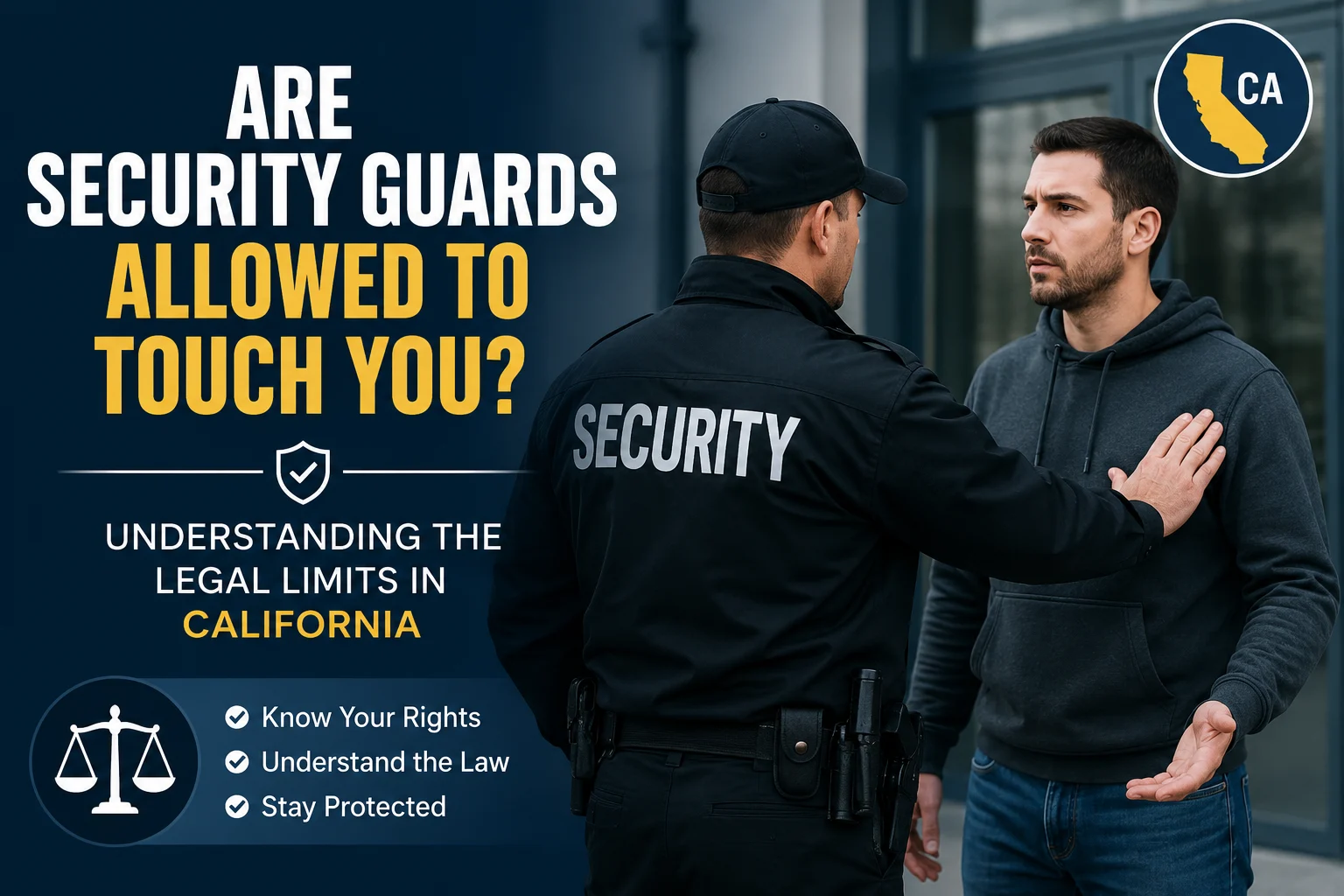
Yes, security guards may legally touch an individual in California under certain circumstances, including self-defense, protecting others, or preventing an immediate threat to safety. However, private security guards do not have the same authority as police officers and cannot use unnecessary or excessive force.
In California, private security officers are licensed and regulated by the Bureau of Security and Investigative Services (BSIS). The rules surrounding physical contact are often misunderstood, especially because private security guards and police officers operate under very different legal authorities.
Key Takeaways
- Physical contact is permitted only in limited situations.
- Most incidents are resolved without force.
- Security officers operate under different rules than police officers.
- Communication frequently resolves problems before they get worse.
Security Guards Are Not Police Officers
One of the most common misconceptions is that private security guards have the same powers as law enforcement officers.
Security guards are hired to protect private property, verify access credentials, document incidents, and, if needed, respond to security concerns until law enforcement arrives.
Their authority generally derives from private property rights and applicable California law rather than from police powers.
That difference is exactly why security guards operate under a different set of rules than law enforcement officers.
When Are Security Guards Allowed to Touch Someone?
Security officers try to avoid physical confrontations whenever possible, but some situations require immediate intervention.
1. Self-Defense
Security guards have the same right as any individual to defend themselves if they are attacked or threatened with physical harm.
For example, if a person punches or assaults a guard while the officer is performing assigned duties, the guard may use reasonable force to protect themselves.
However, once the threat ends, the use of force must stop as well.
2. Protecting Others from Harm
Security personnel may intervene if another person is in immediate danger.
Examples include:
- Breaking up a fight at an event venue.
- Preventing an assault inside an apartment community.
- Protecting employees or customers during a violent incident.
In these situations, the level of force used must be proportional to the threat.
3. Avoiding Immediate Danger
If someone creates an immediate safety risk, a security guard may take action to prevent injuries or property damage.
For example, a guard may physically prevent someone from entering a restricted construction area where heavy equipment is operating or from harming others.
4. During Certain Lawful Detentions
California law allows limited detention authority under specific circumstances, such as suspected theft or criminal activity occurring on private property.
If a detention is lawful, reasonable physical contact may sometimes be necessary to maintain safety or prevent escape while waiting for law enforcement to arrive.
When Security Guards Are Not Allowed to Touch You
There are many situations where physical contact would not be legally justified.
Security guards generally cannot:
- Push someone because they refuse instructions.
- Use force during verbal arguments.
- Physically punish someone for being disrespectful.
- Grab someone simply for refusing to answer questions.
- Use force beyond what is reasonably necessary.
Professional security officers are trained to use communication and conflict-resolution techniques whenever possible.
Can Security Guards Remove Someone From Private Property?
Property owners have the right to control who enters and remains on their property.
Security guards often act on behalf of property owners by asking unauthorized individuals to leave.
If a person refuses, they may be warned that they are trespassing.
Most trespassing incidents finish with a conversation and a request to leave the property.
Can Security Guards Restrain Someone?
Sometimes. If an individual becomes violent, poses a danger to others, or attempts to flee during a lawful detention, physical restraint may be justified until police arrive.
However, improper restraint or excessive force can expose both the guard and the security company to considerable legal liability.
This is why training and explicit procedures are critical in the private security industry.
What Happens If a Security Guard Uses Excessive Force?
Security personnel who exceed their legal authority can face serious consequences, including:
- Civil lawsuits
- Criminal charges
- Loss of licensing
- Employment termination
- Damage to professional reputation
Businesses hiring security providers should ensure officers receive proper training and understand California use-of-force guidelines.
Why Professional Training Matters
Professional security is built around prevention, not confrontation. Experienced officers know that visibility, communication, and situational awareness often prevent slight concerns from becoming serious incidents.
Frequently Asked Questions
Yes. Security guards may make physical contact when acting in self-defense, protecting others, avoiding immediate harm, or handling certain lawful detentions. They cannot use unnecessary or excessive force.
Under certain circumstances, private security personnel may temporarily detain an individual suspected of criminal activity occurring on private property while waiting for law enforcement to arrive.
A detention should last only a reasonable amount of time necessary to investigate the incident or to wait for responding law enforcement officers.
Security personnel may temporarily detain someone for trespassing on private property until law enforcement arrives, provided the situation meets legal requirements.
Security guards may patrol property, monitor surveillance systems, control access points, document incidents, respond to emergencies, issue trespass warnings, and contact law enforcement when necessary.
Security guards generally cannot impersonate police officers, conduct criminal investigations, issue criminal citations, or use excessive force.
Security personnel may direct traffic or control access within private property, but they do not have the authority to conduct traffic stops in the same manner as police officers.
Protect Your Property With Professional Security Services Near You
Every property faces different risks. A construction project has very different security concerns from those of an apartment complex or shopping center, which is why security plans should never follow a one-size-fits-all approach.
First Guardian Security works with businesses and property owners across Southern California to provide trained security officers, mobile patrol services, fire watch coverage, and site-specific protection strategies designed around each client’s needs.
Contact First Guardian Security to discuss your property, business, or project and learn how a professional security presence can help reduce risks and improve safety.