
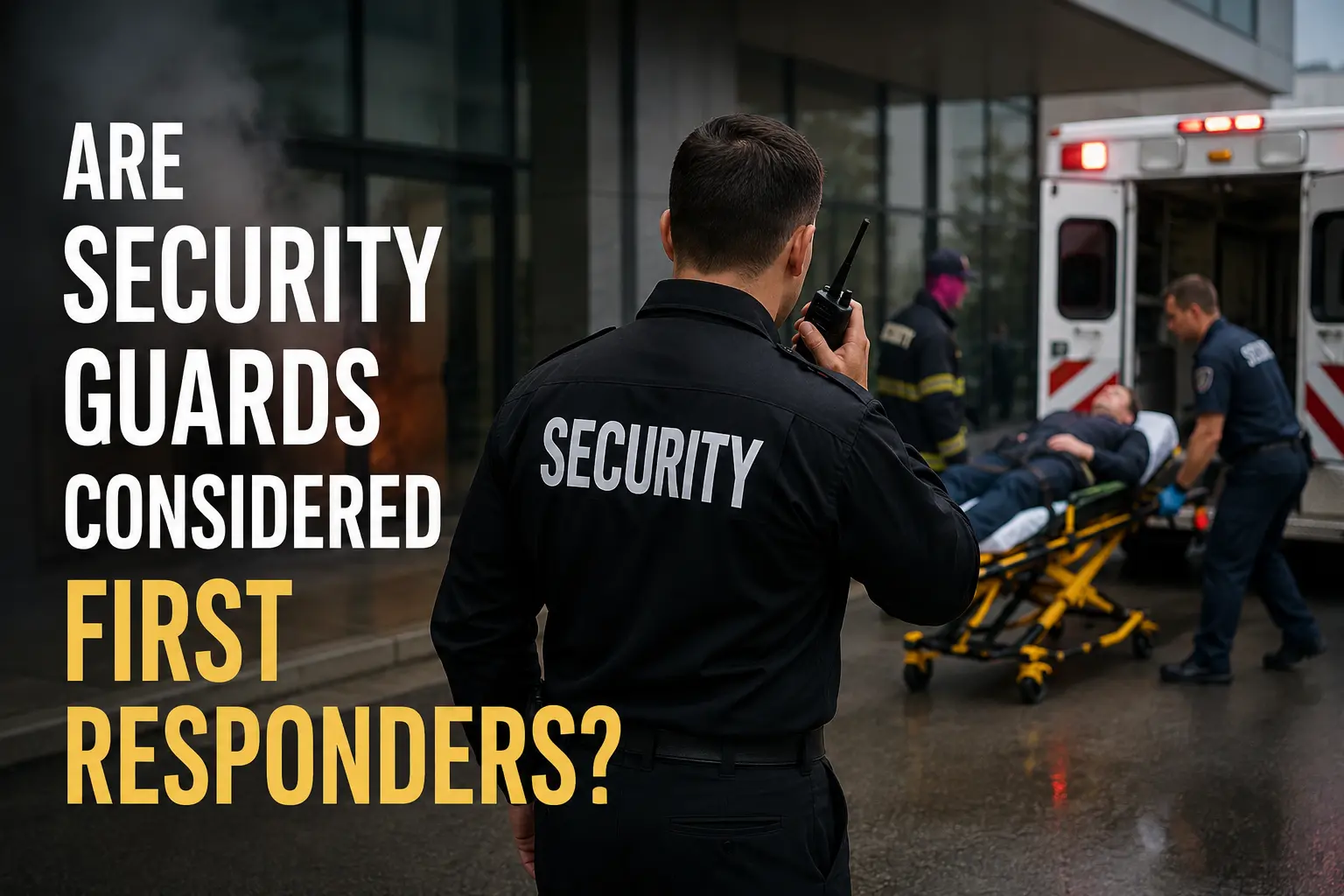
No. Security guards are not legally recognized as first responders in California or elsewhere in the United States. However, they are often the first trained professionals to respond when an emergency occurs on the properties they protect.
Before police officers, firefighters, or paramedics arrive, an on-site security guard may already be securing the area, assisting with evacuations, contacting emergency services, and helping protect people from further harm. Their ability to react immediately makes them a valuable part of any emergency response plan.
Here is a look at how the law defines these roles, where the boundaries lie, and how private security fills the vital gap before public emergency services take over.
Key Takeaways
- Security guards are not legally classified as first responders.
- They are often the first trained professionals on-site during emergencies.
- Their role is to stabilize situations and support emergency personnel.
- Many receive training in CPR, AED, and evacuation.
- Immediate on-site response can reduce injuries and property damage.
What Actually Defines a First Responder?
Legally speaking, a first responder is a public safety official authorized by the government to handle emergencies. This category specifically covers police officers, firefighters, EMTs, and paramedics. These individuals undergo intensive public sector academy training and hold unique legal authorities—such as the power to make arrests, cross private property lines during a crisis, and administer advanced medical care—that private citizens and private security guards simply do not have.
To put this in perspective, the scale of private security in America is massive. According to the U.S. Bureau of Labor Statistics, more than one million security guards work throughout the United States, protecting businesses, hospitals, schools, and residential communities every day. They may not wear a city badge or carry the statutory weight of a police officer, but their physical presence means they are positioned to act long before a 911 dispatcher can route a call to the local precinct.
Are Security Guards Considered First Responders in California?
In California, security guards are regulated by the Bureau of Security and Investigative Services (BSIS) and must obtain a license before working in the private security industry. Although they play an important role during emergencies, they are not legally classified as first responders or peace officers under California law.
Unlike police officers or firefighters, security guards do not have broad law enforcement powers or emergency authority. Their responsibilities are generally limited to protecting people and property on the sites they are hired to secure. Even so, many businesses rely on trained security personnel because they can respond immediately while waiting for public emergency services to arrive.
The Real-World Emergency Duties of a Guard
When that crisis actually hits a job site or business, a security guard’s main job is to contain the chaos until the flashing lights arrive. They are there to bridge the gap, not replace public emergency services.
On any given shift, their emergency duties center on a few critical actions:
- Evaluate the scene: When people panic, a guard steps back to identify immediate hazards—like growing fires or active threats—and maps out a safe response plan.
- Call 911 with precise details: Bystanders in a panic often give dispatchers vague or confusing descriptions. A trained guard provides clear, accurate, and actionable details to emergency operators.
- Manage crowds and evacuations: They guide employees and customers to designated exits, keep emergency doors clear, and actively prevent stampedes.
- Provide basic medical aid: They administer CPR, use an AED, or apply pressure to a wound while the ambulance is en route.
- Secure the perimeter: They cordon off dangerous areas or lock down access points to keep bystanders safe and preserve the scene for investigations.
- Guide first responders on arrival: This saves precious time. A guard waits at the gate or loading dock to wave down the fire truck or police car and directs them straight to the incident via the fastest route.
- Write detailed incident logs: They document exactly what happened, which is vital for insurance claims and police reports later on.
First Responders vs. Security Guards: The Differences at a Glance
| Feature | Public First Responders | Private Security Guards |
| Legal Status | Legally recognized public emergency personnel. | Private contract or in-house professionals. |
| Who They Are | Police, firefighters, EMTs, state troopers. | Licensed armed and unarmed guards. |
| Where They Work | Across entire cities, counties, and states. | Specific client properties and job sites. |
| Legal Power | Broad statutory authority to enforce laws and perform rescues. | Limited authority tied to state property laws and company policy. |
| Primary Mission | Public safety, law enforcement, and advanced medical care. | Risk mitigation, asset protection, and scene control. |
What Legal Authority Do Security Guards Have During Emergencies?
One of the biggest misconceptions about private security is that guards have the same authority as police officers. In reality, their legal powers are much more limited and vary by state law.
In California, security guards can observe, report incidents, protect private property, and request that individuals leave restricted areas. Under certain circumstances, they may also make a citizen’s arrest if they personally witness a public offense or felony being committed. However, any detained individual must be transferred to law enforcement as soon as possible.
Security guards cannot conduct criminal investigations, issue citations, or exercise the broad authority granted to sworn peace officers. Their primary role during emergencies is to stabilize the situation, reduce risks, and support responding authorities.
Why the First 10 Minutes Matter to Your Business
The first ten minutes of any emergency usually dictate how severe the final outcome will be. Public emergency response times vary wildly based on traffic, weather, and how busy local departments are. An on-site guard effectively shrinks that initial response lag to zero.
Having a professional on the property changes the dynamic of an emergency in three specific ways:
- Order Over Chaos: Instead of a building full of confused employees trying to figure out what to do, a guard steps in to take immediate command of the evacuation or lockdown.
- Property and Liability Protection: Quick containment prevents minor incidents—such as a small kitchen fire or a trespasser—from escalating into catastrophic losses or massive corporate lawsuits.
- Fewer Business Disruptions: By managing the scene efficiently, guards help public authorities resolve issues more quickly, allowing your business to get back to work sooner.
Why Immediate Response Matters
During an emergency, the first few minutes often determine the outcome. Even in areas with fast police and fire response times, help may still be several minutes away.
A trained security guard already on-site can begin responding immediately by guiding evacuations, securing dangerous areas, and providing accurate information to emergency dispatchers.
That immediate response can help reduce injuries, minimize property damage, preserve evidence, and improve coordination once police, firefighters, or medical personnel arrive.
In many situations, security guards do not replace first responders — they help bridge the gap until first responders take control of the scene.
Standard Emergency Training
To handle these high-stress situations, professional guards undergo specific certifications. Depending on the industry and the property requirements, this training typically covers:
- CPR, First Aid, and AED operation
- Fire prevention and basic extinguisher mechanics
- Crisis de-escalation tactics
- Active threat awareness and response
- Emergency radio communication and logging
Where Guards Are Needed Most
Emergency situations vary by property type, which is why experienced security guards receive training specific to the environments they protect. The challenges faced at a hospital are very different from those at a construction site or warehouse, and an effective response often depends on understanding the unique risks of each location.
Commercial Offices and Corporate Campuses
In office buildings and corporate campuses, security guards often respond to medical emergencies, unauthorized visitors, workplace disturbances, and evacuation situations. They also help coordinate building access and guide emergency personnel to the correct floor or suite during an incident.
Construction Sites and Industrial Developments
Construction sites present a variety of safety and security risks, including trespassing, equipment theft, fires, and accidents involving heavy machinery. Security personnel help secure restricted areas, assist with emergency access, and support evacuation procedures when needed.
Warehouses and Logistics Hubs
Warehouses and distribution centers frequently deal with after-hours break-ins, workplace injuries, loading dock incidents, and unauthorized access. Because these facilities often operate around the clock, having trained security personnel on-site can significantly improve emergency response times.
Healthcare Facilities and Hospitals
Security officers working in healthcare settings regularly assist with visitor management, medical emergencies, patient disturbances, and access control for restricted areas. Their presence helps medical staff focus on patient care while maintaining a safe environment for employees and visitors.
Retail Centers and Shopping Malls
Retail properties rely on security guards to respond quickly to medical incidents, theft, suspicious activity, and crowd-related issues during busy shopping periods. During emergencies, guards also help coordinate evacuations and keep emergency access routes clear.
Residential Communities and HOAs
In residential neighborhoods, apartment communities, and HOAs, security guards often handle suspicious activity, unauthorized visitors, noise complaints, and emergencies involving residents or guests. Their familiarity with the property allows them to respond quickly and direct emergency responders efficiently.
Concerts, Festivals, and Sporting Events
Large public gatherings pose unique security challenges due to crowd size and rapidly changing circumstances. Event security personnel assist with crowd control, medical incidents, emergency evacuations, and the maintenance of safe access points throughout the venue. Because security guards remain on-site, they can often identify risks early and respond before situations escalate.
How First Guardian Security Handles Emergencies in California
We don’t believe in just putting people in uniforms. Our licensed guards are fully trained to provide security under high-stress conditions. Our licensed guards understand the legal limits of private security, helping keep your business protected and compliant.
We take a highly practical approach to emergency readiness:
- Custom Site Layout Mapping: Before a guard ever sets foot on your property, we map your facility’s layout, water shutoffs, gas lines, and evacuation routes.
- Active Dispatch Communication: Our guards remain in constant contact with our 24/7 dispatch center, ensuring backup or public emergency services are deployed the second a line is crossed.
- Meticulous Incident Documentation: We provide clear, legally robust incident reports that protect your business interests and give law enforcement exactly what they need for post-incident follow-up.
First Guardian Security aim to reduce your risks, protect your people, and keep a cool head when every second counts.
Conclusion
Security guards don’t carry the legal title of a first responder, but their role as a bridge to public safety services is undeniable. Investing in trained on-site security professionals is one of the smartest ways a business can prepare for the unexpected, ensuring that minor incidents don’t turn into major tragedies.
Frequently Asked Questions
No. California security guards are regulated by the BSIS but are not classified as public first responders. They support emergency services by securing property, managing crowds, and coordinating with arriving authorities.
They can sound alarms, call 911, administer basic first aid or CPR, use fire extinguishers on small containment areas, and direct arriving fire trucks or ambulances to the exact location of the crisis.
Yes, provided they hold the proper certifications. Most professional security agencies require their guards to be certified in basic first aid, CPR, and the use of an AED.
Armed guards undergo additional state-mandated firearms training designed for high-risk environments where violent crime is a threat. Unarmed guards focus primarily on access control, patrols, and general emergency support.
They regularly handle localized fires, medical emergencies, trespassing, workplace accidents, vandalism, and building evacuations.
Under specific California laws on citizens’ arrests, a guard can temporarily detain someone if they witness a felony or public offense in their presence, but they must immediately hand the suspect over to local law enforcement.
Because they are already on-site. When a public response takes 10 to 15 minutes, a guard arrives within seconds to control the situation and prevent further damage.
Need Emergency Security Guards in California?
Whether you are looking for long-term property protection or immediate on-site coverage following an incident, First Guardian Security provides fully licensed emergency security guards across California. Get in touch with our team today to discuss your site’s vulnerabilities and get a security plan tailored directly to your operations.